

Closing the Savings Gap: The Power of Financial Education
In part two of our Women in Work series with Mercer experts, we examine how career breaks, part-time working penalties and investment confidence hurdles create a savings deficit threatening individual futures. From Gen Z graduates to women approaching retirement, each generation faces unique financial barriers requiring tailored solutions and strategic employer intervention.
Conversations about workplace equality often focus on pay disparities, but there's a similarly pressing crisis unfolding: women across all career stages are falling behind in their ability to build long-term financial security.
From Gen Z graduates entering the workforce to women nearing retirement, barriers are creating a savings deficit that threatens not just individual futures, but the resilience of our entire economy.
The savings gap develops differently across generations, requiring employers to understand and address the unique challenges facing women at every career stage.
The multi-generational challenge
For Gen Z and younger millennials entering the workforce, the challenge begins with basic financial literacy. "You don't know what you don't know," explains Stef Goodwin, Senior Financial Education Consultant at Mercer Private Wealth UK. "If your parents had defined benefit pensions, the old final salary schemes where they didn't really have to make too many decisions for themselves, they may struggle to educate their children on the inner workings of a defined contribution pension, where all the decisions (unlike defined benefit) are on them."

This generational shift in pension responsibility, from employer-managed to employee-managed, has created a knowledge vacuum. Young people are entering careers without understanding the power of compound growth or the tax advantages of early pension contributions.
The consequence? They're missing out on decades of potential growth, at the very moment when time is their greatest asset.
For women in their thirties and forties, the challenges multiply. Career breaks, part-time working, and what Goodwin describes as "the motherhood penalty" create significant obstacles to consistent saving. Women are 2.5 times more likely than men to work part-time (with 36% of women in employment working part-time, compared with 14% of men) and significantly more likely to take career breaks, which has a knock-on effect on their lifetime earning capacity and saving opportunities.
Women carry out an overall average of 60% more unpaid work than men, which directly limits their earning capacity and, consequently, their ability to save. This care burden often extends beyond childcare to include caring for elderly parents, creating the so-called sandwich-generation effect (where individuals simultaneously care for aging parents and their own children) that compounds the savings challenge.
Women: career-long disadvantages
For women approaching retirement, the cumulative effect of these career-long disadvantages becomes stark. With pensions making up only 32% of retirement income according to data from Mercer's Destination Retirement service (with the remaining 68% coming from other sources such as ISAs, property, and other investments), many are facing the reality that they simply haven't been able to save enough.
The scale of this challenge is staggering. According to Mercer's Road Map for Pensions and Long-term Savings, only 3% of millennial households with median income are projected to meet a "moderate" standard of living in retirement. Meanwhile, data from the Pensions Policy Institute’s Underpensioned Report 2025 reveals that two-thirds of the UK population retire with an average annual income of just £3,650. For women, the picture is even bleaker, with the UK gender pensions gap averaging £6,000 annually.
The long-term projections are equally alarming. As set out in Mercer’s Road Map for Pensions and Long-term Savings, the World Economic Forum estimates the pension gap in 2050 will reach £25 trillion, while approximately 17 million adults in the UK are currently not saving enough for later life. With pensions making up only 32% of retirement income, according to data from Mercer's Destination Retirement service, the majority of retirement funding must come from other sources – sources that many women struggle to build, due to career-long disadvantages.
The investment confidence hurdle
Beyond the mechanics of saving lies another critical barrier: the investment confidence hurdle. Even when women do manage to save, they're less likely to invest those savings in growth-oriented assets, potentially limiting their long-term returns.
"There's still this investment hurdle and women's risk appetite in terms of what they actually do with their savings if they have them," Goodwin points out. This risk aversion, while understandable given women's often more precarious financial positions, can paradoxically worsen their long-term financial outcomes.
The roots of this confidence gap often trace back to early financial socialisation. Goodwin recounts a conversation with a client whose father had discussed pensions with her brothers but not with her – not from any belief she was less capable, but from unconscious bias. These "blind spots," as Goodwin terms them, can perpetuate spirals of financial exclusion.
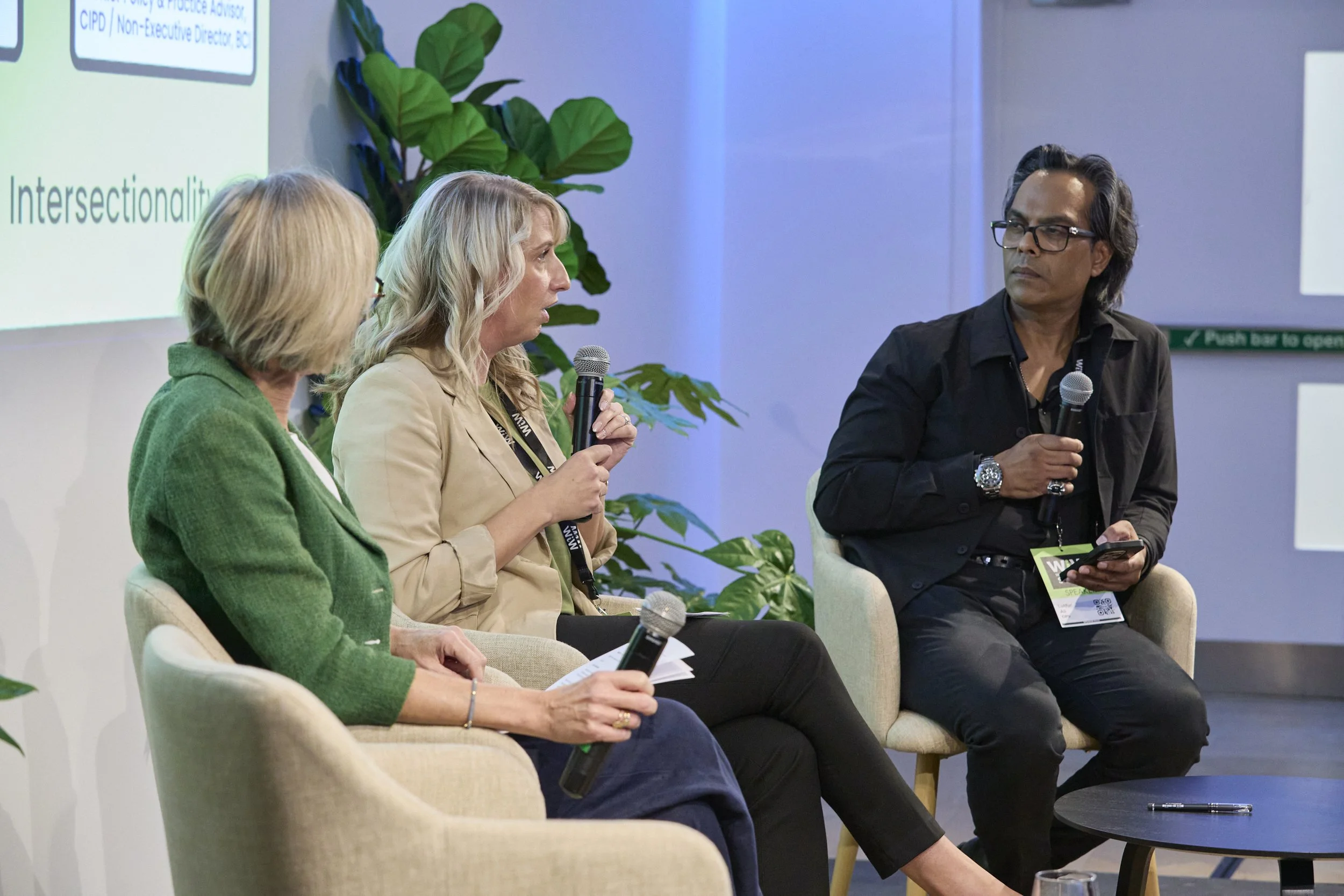
Stef Goodwin speaking at the Women in Work Summit 2025
The employer imperative
So why should employers care?
Because the business case for addressing the savings gap extends far beyond corporate social responsibility.
According to the CBI/Mercer People & Skills report 2021, more than 4 in 5 (86%) of senior executives believe there is a strong business case for providing a competitive workplace pension, while an equal percentage think it is their moral obligation to contribute to employees' pensions to help them save for retirement.
Already, 8 in 10 (82%) businesses offer contributions above the statutory minimum of 3% (for employers) as part of their employee benefits package, and more than 3 in 5 (65%) senior executives believe that, where businesses can, they should pay more than the minimum statutory contribution (3% for an employer) into automatic enrolment schemes.
Financial stress directly impacts workplace performance, with financial uncertainty having "a negative impact on our overall wellbeing – and therefore it can have a negative impact on how you present, and how you perform, at work," Goodwin explains.
Moreover, if employees can't afford to retire, they won't. This creates succession planning challenges, which can prevent career progression for younger employees. "If people are not adequately prepared for retirement, they're not going to be able to retire. And that, obviously, is a block from an employment perspective as well," says Goodwin.
Tailored solutions for every generation
The key to closing the savings gap lies in recognition that different generations need different support. "Good looks like understanding what their people need and not just delivering generic education that employers assume might be right," Goodwin says.

For Gen Z and younger millennial women: Employers should focus on foundational financial literacy, starting with basics like taxation, budgeting, and goal setting. The power of compound growth needs to be made tangible and relevant. Education should cover government savings schemes like Lifetime ISAs, while emphasising the importance of building both accessible savings and long-term pension wealth.
For women in their thirties and forties: Support needs to acknowledge the reality of career breaks and part-time working. This might include guidance on front-loading pension contributions before career breaks, maximising employer contributions during reduced hours, and understanding how to "backfill" savings gaps after returning to work.
For women approaching retirement: The focus shifts to maximising remaining earning years, understanding pension options, and creating realistic retirement income strategies. Crucially, the message must be that "there's never a point at which it's too late," even if dramatic change isn't possible.
Breaking down barriers
Goodwin acknowledges that effective financial education requires more than generic workshops. She advocates for a curriculum-based approach that builds knowledge progressively, ensuring there are no gaps in fundamental understanding before moving to more complex topics.
While group sessions work well for foundational knowledge, individual guidance sessions are crucial for addressing personal circumstances. "Understandably, people don't often want to discuss their own personal circumstances in an open forum," Goodwin explains. "Individual guidance sessions give somebody a safe space to discuss where they are at the moment, what their challenges are."
The emergence of AI presents new opportunities to scale personalised financial education. With 987 million people already using AI chatbots globally, and 70% of customer interactions expected to involve AI technologies by 2025, AI-powered financial education is becoming mainstream. AI chatbots can provide personalised learning experiences, adapting to the user's knowledge level and offering instant, customised responses.
For employers, this could mean offering 24/7 financial guidance that complements human-led sessions, potentially addressing the privacy concerns that make employees reluctant to discuss personal circumstances in group settings – though research is still emerging on user preferences for AI versus human interaction in sensitive financial discussions.
Importantly, this education must address specific challenges women face. Around 60% of women don't discuss pensions as part of divorce settlements, focusing instead on immediate concerns like housing. Financial education needs to address these blind spots explicitly.
While the savings gap represents a significant challenge, and there has been progression over time with the picture ever improving, it's not insurmountable. The key lies in recognising that financial decisions are never made in isolation; they're shaped by life circumstances, caring responsibilities, and societal expectations.
"Employers who invest in comprehensive, tailored financial education aren't just fulfilling a moral obligation; they're building more resilient, engaged workforces," says Goodwin. "When employees feel confident about their financial futures, they're more productive, more loyal, and better able to plan for transitions, including retirement."